Are images a direct SEO ranking factor, or are they just a nice-to-have and an afterthought that should come secondary to the content that you put on your website?
It’s a valid question. We all know that adding images to your website can improve the look and feel, potentially keep users on your site for longer, and provide a better on-site user experience.
However, do images actually improve how you rank in the organic search results?
In this article, we’ll explore some of the most common misconceptions about SEO and images and provide some best practices to get the most out of the images that you add to your website, for your rankings and for your on-page user experience.
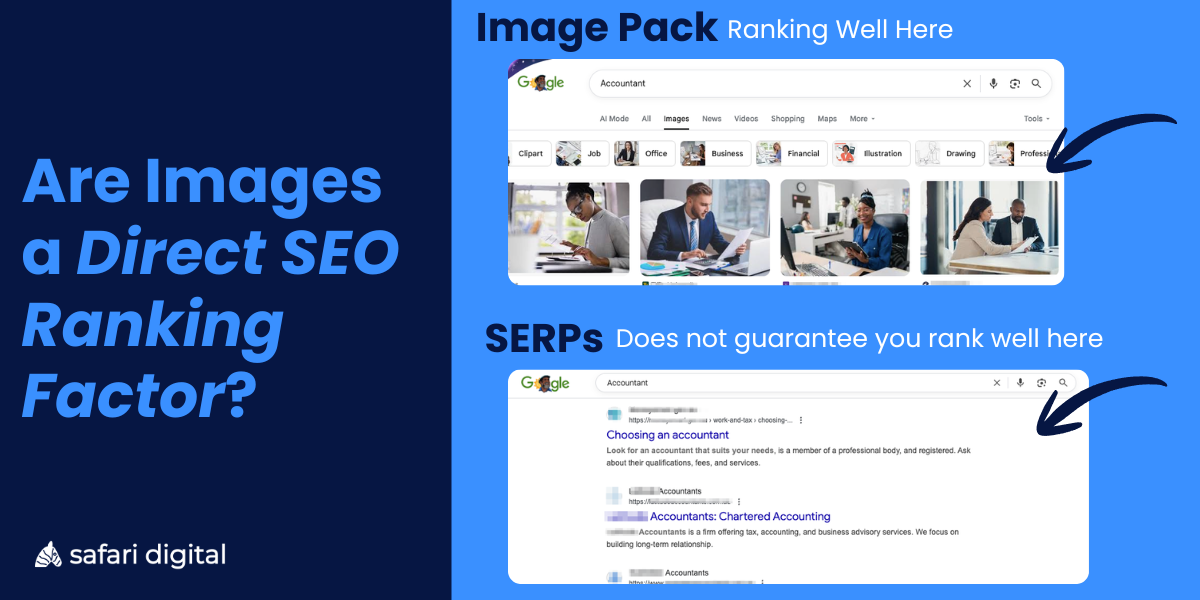
Q. Are Images a Direct SEO Ranking Factor?
Answer: No, images are not a direct SEO ranking factor.
There is a lot of conflicting information and conjecture about whether images actually enhance your SEO rankings; however, it’s important to understand that images are not a direct SEO ranking factor.
Unlike other factors like content quality, page speed, page titles, and backlinks, images do not directly impact your SEO rankings.
So then, if images aren’t a direct SEO ranking factor, does that mean that you should not use them and they aren’t worth your time? Definitely not.
Here’s the thing: whilst images are not considered to be a direct SEO ranking factor, they still provide a myriad of benefits for users on your website, which can indirectly impact how your website ranks in the organic search results.
Why Images Are Still Worth Your Time and Effort
So then, images are not considered to be a direct SEO ranking factor, but that does not mean you should ignore them or neglect them for your on-page SEO efforts.
In fact, there is a strong enough correlation between websites that rank well and websites that have optimised images to suggest that images have a substantial indirect benefit for SEO rankings.
As with anything in the SEO space, correlation does not equal causation. What that means is that we can presume that websites that go to the effort of creating engaging and relevant images, uploading them with correct file names and alt text, and optimising them for SEO probably already have a strong SEO strategy that flows around. In other words, images are simply a part of an already strong on-site SEO process.
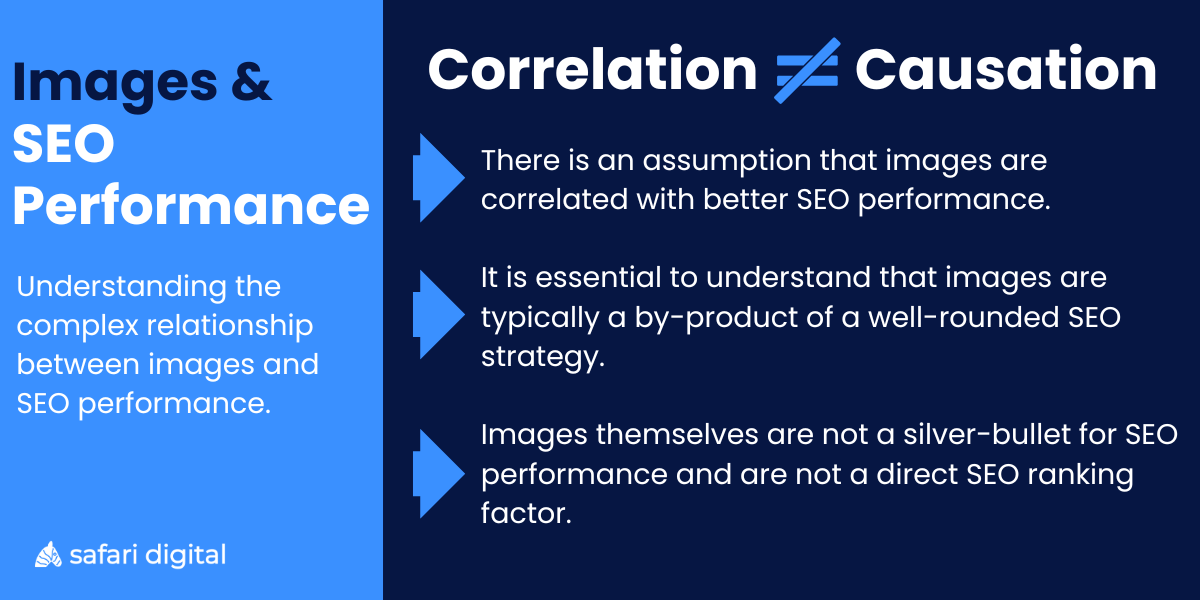
By the power of deduction alone it’s hard to say that images equal stronger SEO rankings; however, there is an undeniable link between websites that perform well in the organic search results and those that go to the trouble to create unique and engaging images that are uploaded following SEO best practices.
Are Images Important for SEO?
Images may not be a direct SEO ranking factor; however, they are still an essential piece of the SEO puzzle that is worth your time and effort.
Images improve on-site user experience, increase time on page, and help to create a more engaging web page.
Even though Google has stated that bounce rate is not a direct SEO ranking factor, a 2024 leak of internal Google Search API documents from the “Content API Warehouse” did seem to indicate otherwise. In this leak, it was revealed that Google tracks Chrome user interactions such as time on page, clicks, and general browsing behaviour. If we think about this in the context of images and SEO, this means that websites with images are likely providing strong, positive user signals.
Irrespective of whether or not images are a direct SEO ranking factor, they are certainly worth your effort. We recommend creating unique, helpful images that enhance user experience, break up chunks of text, and create a more engaging on-site experience.