Click-through rate, or CTR, from the search engine results pages to your website might just be one of the best real-world indicators of whether your page is meeting search demand.
After all, if someone is clicking from Google onto your website, then surely that means that Google has done a good job with the results that it’s serving up, right?
But does Google use CTR as an SEO ranking factor, or is it just a bit of SEO folklore?
The argument for CTR as an SEO ranking factor
The case for CTR as an SEO ranking factor has always sort of been built on speculation. The rationale is pretty simple. Let’s say you have two websites:
- Website A is ranking in position number one and gets a 30% click-through rate.
- Website B is ranking in position number two and gets a 60% click-through rate.
In this example, you would assume that website B is a closer match to what the searcher was looking for, right?
Well, in theory, it would be correct, but it’s important to remember that there are other biases that come into the way that we click. For instance:
- Let’s say that Website B is enjoying a significantly higher click-through rate because it is a recognised brand name compared to website A.
- Website A might be providing a significantly better result for the user. The information might be more in-depth, newer, more accurate and meet Google’s standards far better than website B.
In that example, does that mean that Google should switch the rankings, or have they got things correct?
Did Google’s 2024 leak confirm CTR as an SEO ranking factor?
For as long as I can remember being an SEO professional, the case for CTR as an SEO ranking factor was always built on speculation and limited data tests.
Every few years, someone would publish a study. The study would typically conclude one of two things:
- Study A: Conclude that CTR was an SEO ranking factor based on a limited testing pool.
- Study B: Conclude that the data was not good enough to say that CTR was an SEO ranking factor.
And that’s pretty much how things went for the last decade or so.
In 2024, however, the Google Content Warehouse API documentation leak threw a bit of a spanner in the works.
The documents, which were accidentally made public on GitHub between 27 March and 7 May 2024, and were later indexed by a third-party service, introduced the idea that clicks may be being used as a ranking factor.
The main system used by Google is NavBoost, and the documentation references features like good clicks, bad clicks, last longest click, impressions and unicorn clicks, tied to systems called NavBoost and Glue, which Google VP Pandu Nayak confirmed in the DOJ testimony are all part of Google’s ranking system.
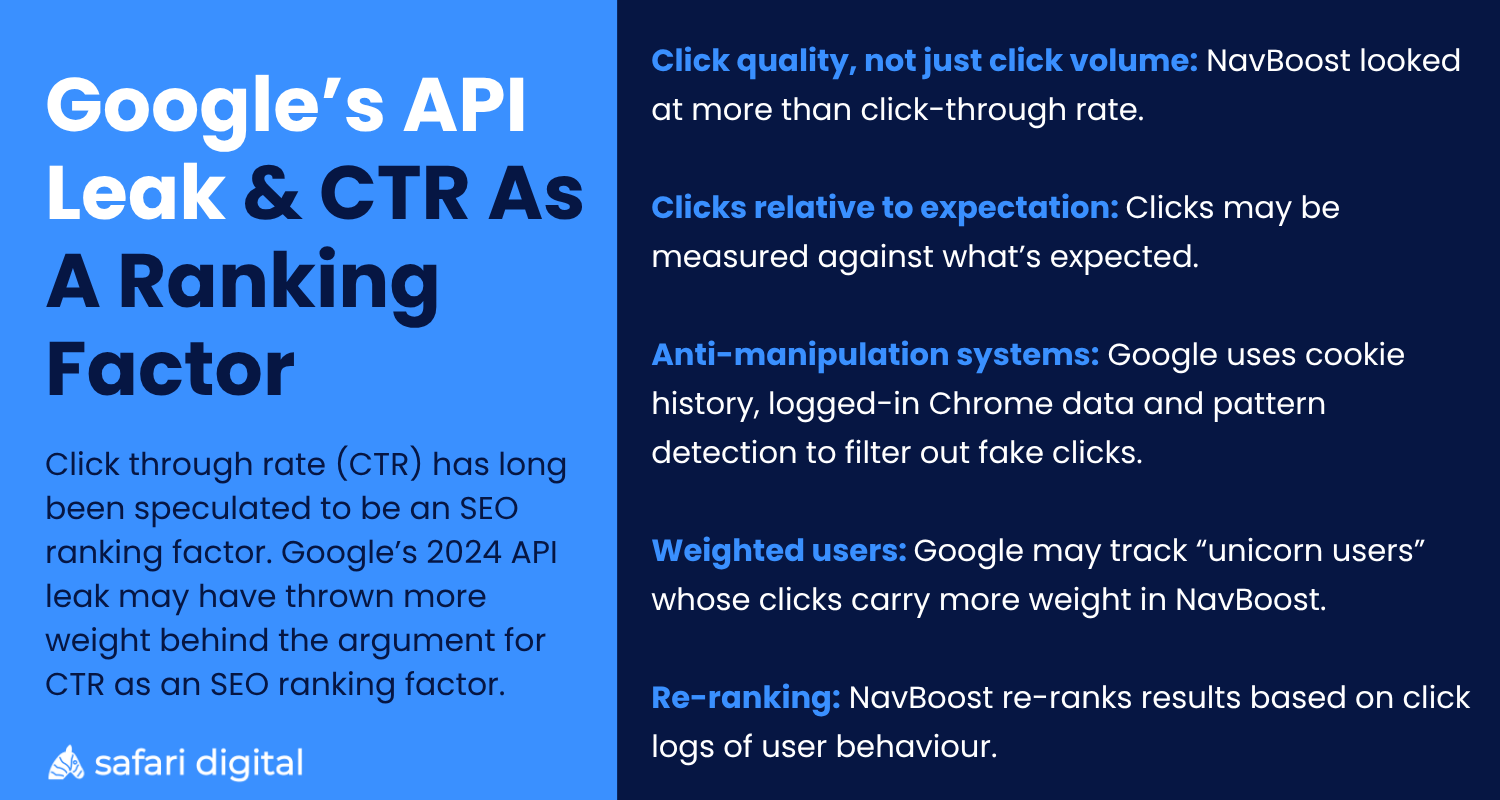
The leak filled in a lot of the speculative details around clicks as an SEO ranking factor and introduced a few key ideas, namely:
- Click quality, not just click volume, was used as a ranking factor. In other words, the number of times someone clicks through to the website and boosts the click-through rate wasn’t the only thing being used by NavBoost. Instead, factors such as bad clicks (bounces from the website) and last longest click (time spent on the website once clicked through) meant that users didn’t need to keep looking.
- Clicks relative to expectation.
- Anti-manipulation systems used by Google, such as cookie history, logged-in Chrome data and pattern detection.
- Weighted users, suggests Google may be tracking a number of unicorn users whose clicks may carry more weight in the NavBoost ranking system.
- Information about re-ranking, and how NavBoost is re-ranking based on click logs of user behaviour.
The Google Content Warehouse API documentation leak was a big deal.
More specifically, it was a big deal when it came to the speculation around CTR as an SEO ranking factor. In the past, the closest we’d had to confirmation came from representatives like Gary Illyes consistently describing CTR as a “very noisy signal” and saying that using clicks directly in rankings would be problematic because of manipulation.
The takeaway from the documentation wasn’t just that NavBoost was being used, it was also that it didn’t specify the relative importance of any of the attributes.
Is CTR an SEO ranking factor?
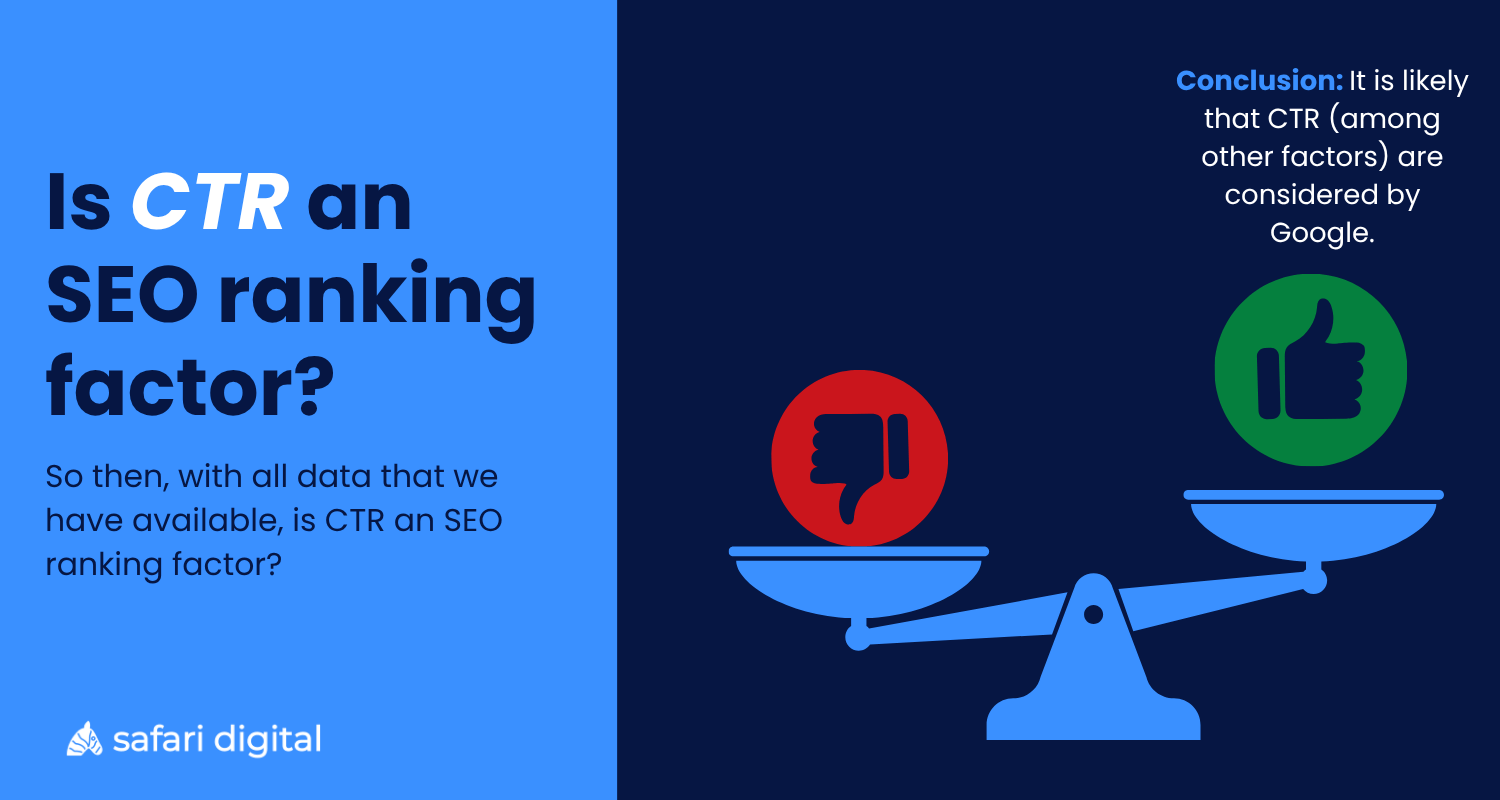
The Google Content Warehouse API documentation leak in 2024 threw more weight behind the argument that CTR may be used as a ranking factor – but not enough to conclusively say that CTR in isolation is an SEO ranking factor.
Concluding that CTR is definitely an SEO ranking factor is probably too definitive based on the evidence that we have.
The reality is that Google is likely using a whole range of click metrics to determine rankings. Simply saying that a higher CTR without considering the other click metrics is too conclusive and does not consider the variables.
Should you take notice of click through rate (CTR)?
Yes. You absolutely should be looking at your CTR as part of SEO tracking. Irrespective of whether or not we can conclude that CTR is used as an SEO ranking factor, click through rate is still one of the most important indicators of whether your content is meeting the expectations of the user. Setting a baseline for CTR against keywords or pages on your website is an important way to track performance over time.