SEO has never been more complicated.
The days of shortcuts and SEO hacks are well and truly in the rear-view mirror.
As an SEO agency, we’ve had front row seats to countless SEO mistakes and missteps by businesses. In this list, we summarise the most common SEO mistakes that we are seeing in 2026 and provide cautionary advice for any business owner looking to keep their business on the right path in 2026 and beyond.
SEO Mistake 1: Creating & Publishing AI Generated Content
Creating and publishing AI generated content is – by far – the biggest SEO mistake that we have seen businesses make over the past 2-3 years.
Nothing ignites debate in the SEO community quite like telling someone that AI should not be used to generate your content. However, that’s exactly how we’re going to start this list.
AI generated content isn’t just the number one on our list of the biggest SEO mistakes that we see day in, day out as an SEO agency – it also the biggest catalyst for established websites collapsing in 2026.
A timeline of the AI content apocolypse
We first started to see the catastrophic impact of mindlessly generated AI content in late 2022, when tools like Jasper first came onto the market. For businesses, the advent of these tools basically meant that they didn’t need an internal copy team anymore and they could scale content very quickly.
The issue with misinformation
There is a biblical amount of conjecture and conflicting information out there around using AI tools to write or assist with content creation. In fact, every morning when I open LinkedIn, we see people who spruik the merits of using AI to create content. Everyone thinks that they have found a hack or a shortcut.
My default for checking whether they are good at posting on LinkedIn or good at SEO is to check the website that they have been working on. This has been my default for the last few years. If someone says that they have found a method, or they have successfully used AI generating content, then we look at their website in Ahrefs to see how successful it is being first hand.
The truth is, it is very easy to convince people on LinkedIn; it is much harder, however, to get results using those methods yourself.
The impact of AI content in action
There was a great study published by Lily Ray on Substack in May 2026 titled “It Works Until It Doesn’t: AI Content Strategies That Backfire”. In this study Lily looked at 220+ sites that were listed as the success stories on the websites of a well-known AI content generation tool. In essence, these sites were the posterchild of how AI content could be used successfully to improve SEO outcomes. The reality, however, when looking at these sites through third party SEO tools was very different to what was claimed.
There was a consistent pattern of rapid growth followed by a significant decline. Of the websites that were mentioned as case studies, 54% lost 30% or more of their peak traffic and 39% lost 50% or more.
Google is predictably ambiguous on the subject of using AI tools for creating content. Their current stance is:
“Appropriate use of AI or automation is not against our guidelines. This means that it is not used to generate content primarily to manipulate search rankings, which is against our spam policies.”
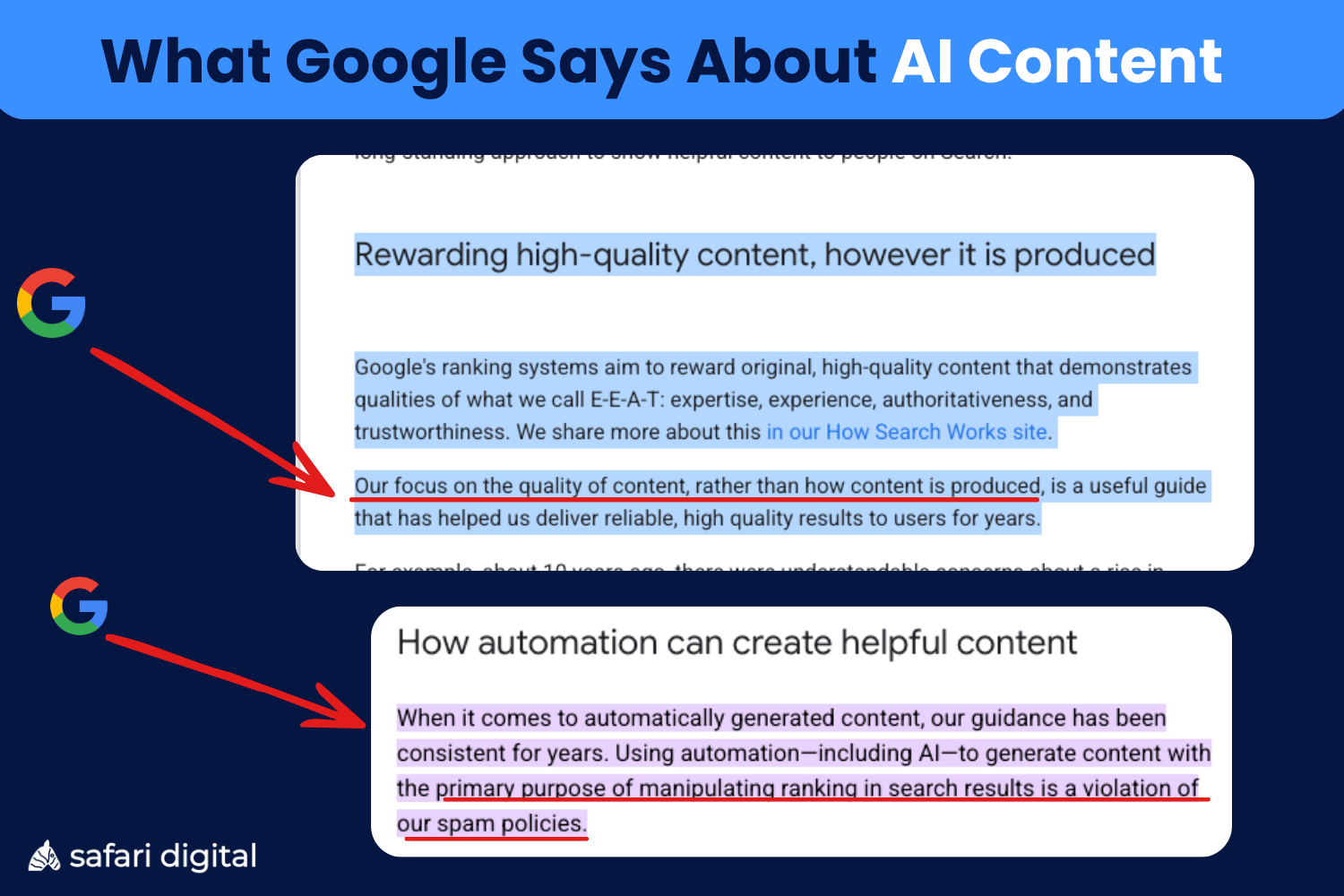
Interpret that how you will. Even using the most optimistic interpretation possible you would be hard pressed to frame this as a green light for how most people are creating content using AI tools.
What we have observed
After auditing more than 300 websites since late 2022 when AI content started to pick up steam, we can categorically say that there has been no instance where a business has consistently used AI content across the website and seen a positive change. Granted, when people approach us as an SEO agency they’re usually coming to us off the back of concerns about their traffic. However, we see this across countless industries.
SEO Mistake 2: Publishing Low-Value Content at Scale
Publishing low-value content at scale is a continuation of the AI content issue that we mentioned above. However, due to the sheer volume of websites publishing thousands of articles on autopilot, it’s worthy of its own point in a list of the most common SEO mistakes that we see in 2026.
Below is a perfect illustration of this. This prospective client came to us after publishing almost 3,000 articles in a period of eight weeks. Basically, they plugged their website into an AI content generator that was publishing dozens of articles every day.
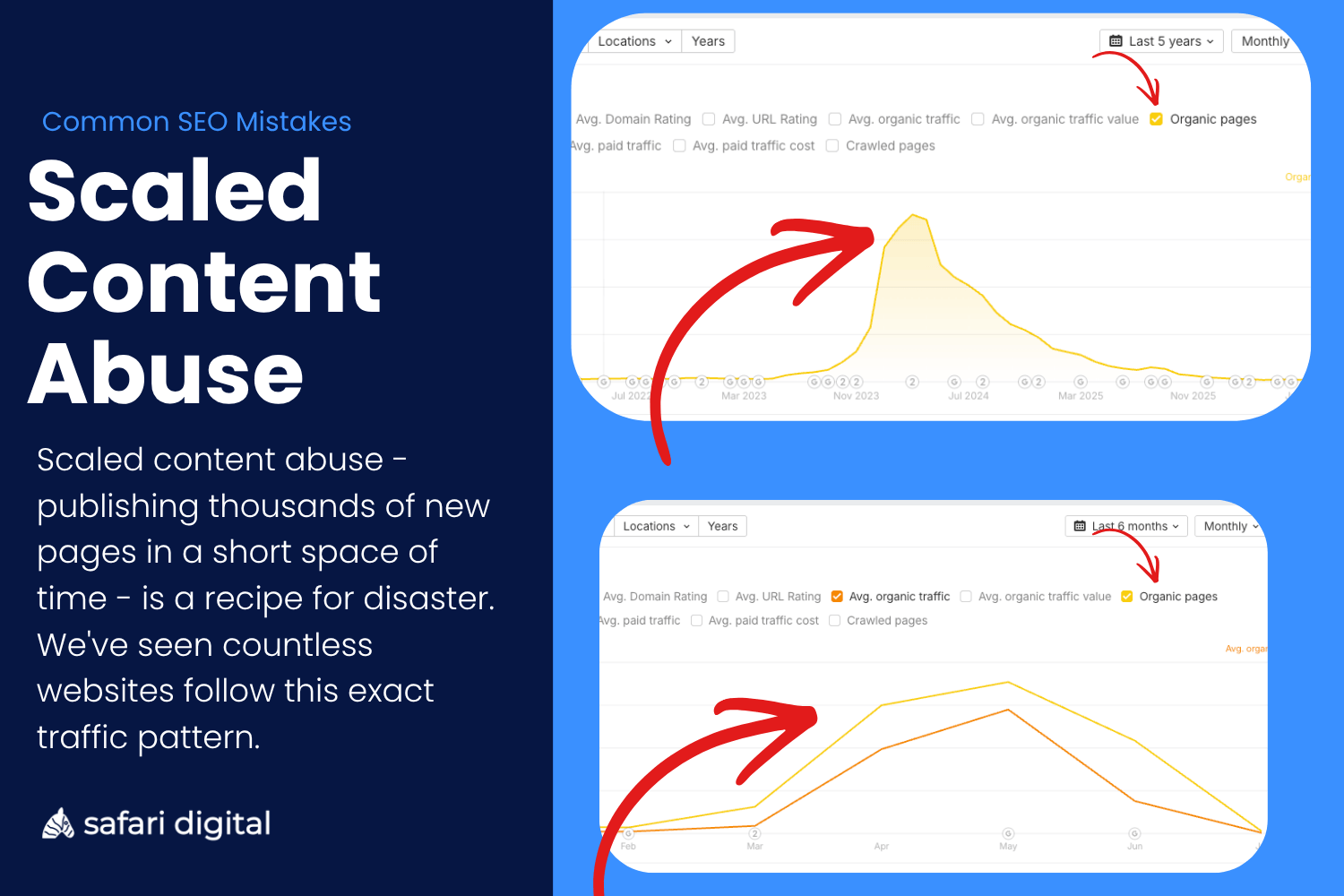
There were two issues with this:
- the content that was being published was obviously AI generated and provided little to no unique insight.
- the type of content which was being created was so far removed from what that business actually focused on.
For instance – without giving away the identity of this client – let’s say that they were a law firm in Sydney, Australia. The types of articles that they were publishing were things like “what are the best things to do when visiting Sydney.”
Yes, that’s great, however why is a law firm telling me what I should be doing on my holiday?
Publishing low-value content at scale is the new programmatic SEO. Ten years ago, creating content at scale meant using things like AI spinners or programmatically developed content with variables through the text.
Today it means providing your site logins to an AI content tool and then letting it run on autopilot. In our reckoning, low value content at scale is the biggest mistake that businesses can make.
Google Search Advocate John Mueller confirmed back in 2022 that these tactics fall into the well-established category of web spam:
“For us these would, essentially, still fall into the category of automatically generated content which is something we’ve had in the Webmaster Guidelines since almost the beginning. And people have been automatically generating content in lots of different ways.”
“And for us, if you’re using machine learning tools to generate your content, it’s essentially the same as if you’re just shuffling words around, or looking up synonyms, or doing the translation tricks that people used to do. Those kind of things.”
It’s important to understand that publishing this type of content doesn’t just affect your blog or the articles themselves – it affects your entire website. Google uses a sitewide quality assessment to determine where your most important pages should be ranked.
In the instance mentioned above, if you’re a lawyer and you want to rank for things like “divorce lawyer” or “family lawyer,” and you’re publishing irrelevant articles about travel tips in Sydney, then Google quickly loses context for what your business does and why they should be ranking you for those terms.
The most important thing is to stick to your expertise when creating content. Don’t veer too far out of your lane. Niche down and focus on what your prospective customers actually want and provide real value and insights on those topics.
SEO Mistake 3: Spammy Link Building
Spammy link building violates Google’s spam policies and continues to be one of the most common SEO mistakes that businesses make in 2026.
Spammy link building is nothing new.
The definition of spammy link building hasn’t really changed in the last decade. Any links which are acquired for the explicit purpose of inflating search rankings or “tricking search engines”. Google’s penguin update back in 2012 was the day of reckoning for link spam. However, since then, Google has continued to refine and improve link spam detection.
Google’s spam and pattern detection has improved precipitously during this time.
For most people, the first thing that comes to mind is paid links. However, paid isn’t the only definition.
There is very obvious spammy link building tactics which include:
Link building is time consuming. Effective links aren’t easy and easy links aren’t effective. When in doubt, consult with an off-site SEO specialist. One wrong step with your link building efforts can set you back for years.
SEO Mistake 4: Stop-Start SEO Strategies
Stop-start SEO strategies refer to committing to SEO – whether through your own means or by partnering with an SEO agency – for a short amount of time before stopping again.
Stop-start SEO is surprisingly common. Here is what it looks like in practice:
- A business realises that they should be doing SEO because they’ve seen their competitors at the top of Google.
- The business invests in SEO with an agency or SEO consultant.
- They don’t see results in the short term, and they believe that SEO is a sunk cost.
- They stop doing it before giving the agency/consultant a chance to get results
One of the most important things that we say to any prospective client when they’re looking to do SEO is that the commercial outcomes of working with a good SEO provider and a bad SEO provider don’t look that different in the first 3-6 months.
Basically, it doesn’t matter whether you’re working with a good SEO agency or a shady SEO practitioner – the commercial outcomes are going to look pretty similar. SEO takes time – the first few months are about implementing the groundwork and building momentum.
That doesn’t mean that things won’t be done on the website. However, the business outcomes of more calls, more sales, more enquiries are not going to be drastically different – they are both going to be low. SEO takes time. Whether you are working with a great agency or a shady practitioner, it’s really hard to find out in the first few months.
Before we work with any business, we always do due diligence. Based on the current position of the business, we should be able to provide a realistic timeline for how long it’s going to take to see results. In many cases, we get pushback and people say, well, can you do it in a shorter amount of time. The issue is that many SEO agencies and practitioners will fold to these requests and say yes, it can be done in a shorter amount of time, all the while knowing that it cannot.
Stop-start SEO arises out of poor communication between a business and an SEO professional.
If a business is aware of the time frame before they start, then they will either:
• decide that they don’t want to start SEO, or
• they will be more understanding of the time when they start
We say the same thing to businesses before they start: if you cannot commit to doing SEO for at least 12 months, then we recommend investing that marketing budget elsewhere.
Yes, you will see results within the first 6 to 12 months. However, we recommend that if you don’t know whether you will be able to cover the sunken cost of SEO for at least 6 months, then you are better off not starting, rather than potentially investing for five to six months, getting half-baked outcomes, and then starting up again in a few months.
SEO requires momentum – on-off investing is one of the most common SEO mistakes that we see and leads to poor outcomes.
SEO Mistake 5: Chasing 100% on A Third-Party SEO Tool
Chasing 100% on a third-party SEO audit tool is one of the most common SEO mistakes that we see.
It doesn’t matter which SEO tool you use – whether it’s Ahrefs, Semrush, or any other popular SEO tool – they all provide a fairly similar audit that points out technical issues on your website.
The problem with these tools is that they are very good at telling you what is wrong, but don’t provide any context for what actually needs to be done and what is worth your time and attention.
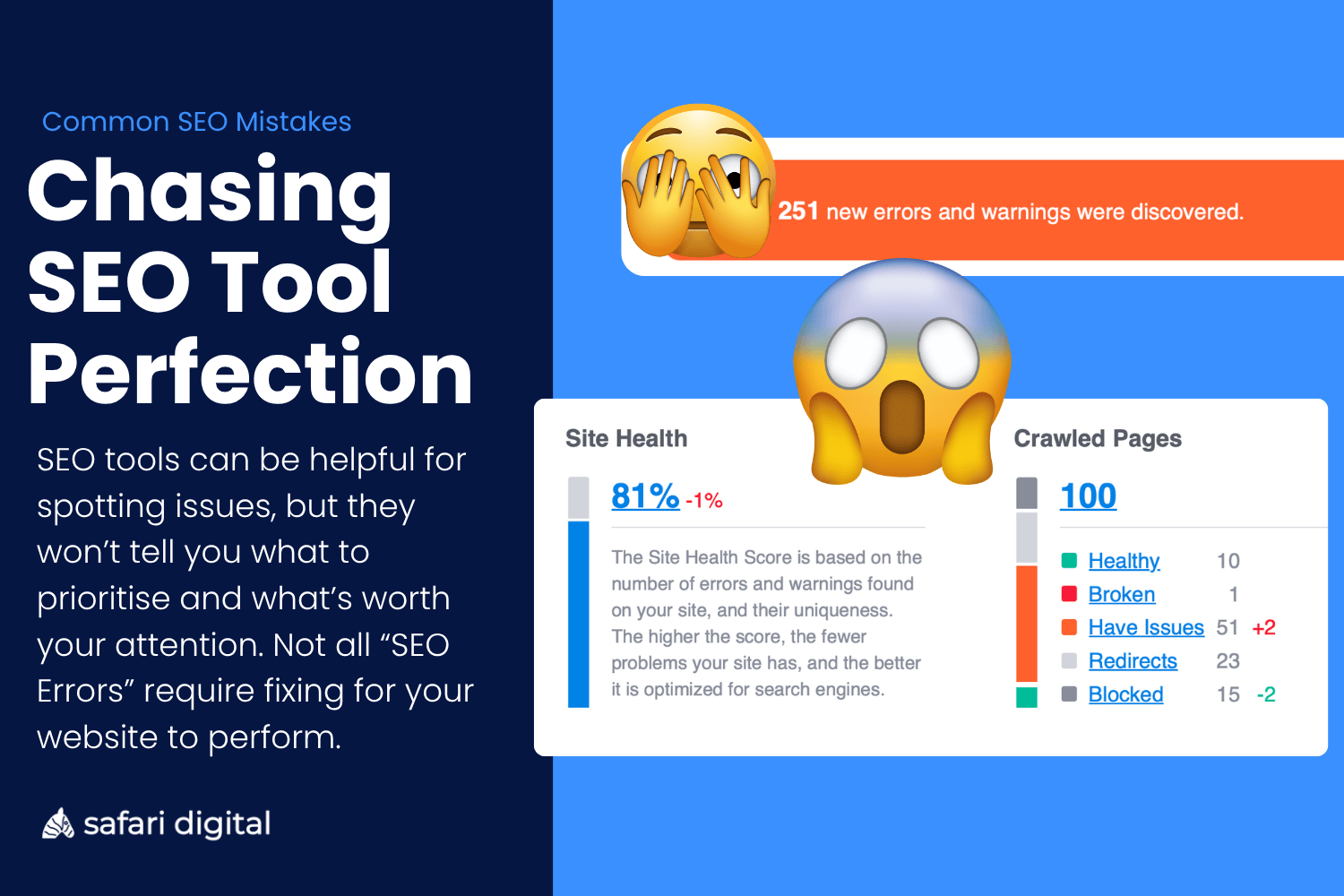
Not all problems that are reported through a third-party SEO audit are worth your attention.
We’ve written about this previously in an article about SEO audits, which summarised that an SEO audit is only as valuable as the person who interprets it. You can get 100% on a third-party SEO audit tool and still get zero organic traffic. Conversely, you can score 15 out of 100 on one of these tools and receive millions of organic visitors a month.
Google and other search engines do not care about third-party SEO audits. Yes, these tools can sometimes be helpful for identifying issues on the website. However, they should not be used to guide your SEO strategy.
Third-party SEO tools are very confident with pointing out technical faults, however, very flawed at understanding the nuances of SEO. In the hands of an SEO professional who know what they are doing, these audits can be useful. In the hands of an inexperienced SEO or a business owner, they are cause for panic without context.
SEO Mistake 6: Publishing regularly for the sake of it
One of the most common SEO mistakes that we see site owners make is publishing content for the sake of it. Whether they are trying to stick to a publishing schedule or (wrongly) believe that frequency = results. Publishing content for the sake of it or because you are trying to meet a quota is the wrong approach.
Today, more than ever, there is an abundance of content. The point of difference between you and your competitors won’t be the volume of content, but rather the quality of content.
Google’s information gain search algorithm theory evaluates how much unique and added information a web page adds compared to existing content on the topic. If you’re looking to publish new content – then this should be the main metric/litmus test. Focus on publishing content that adds something new to the conversation. Add first hand data, report on first-hand experience, and add a new angle to the conversation. Simply reporting back what users (and search engines) already know exists won’t yield positive SEO results.
SEO Mistake 7: Leaving content to decay
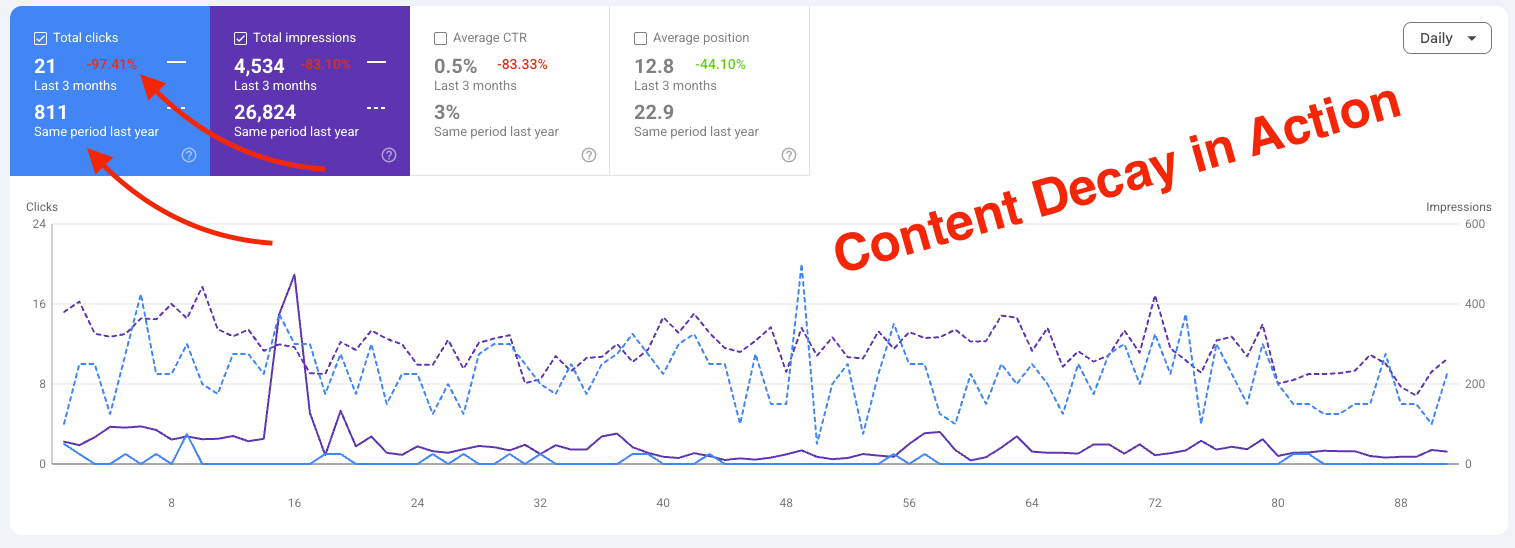
Content decay is the gradual decline in a web page’s organic traffic and overall search visibility and it’s one of the most common SEO mistakes that we see.
Publishing great content and achieving a lot of traffic does not automatically guarantee future performance. Over time, content “decays” and gradually loses search engine visibility. New competitors come along and post something that is more relevant, recent, or adds a new perspective and all of a sudden, your content begins to slide down the SERPs.
Instead of the relentless pursuit of publishing new content, you should be focussing on preserving what is already working and keeping your most valuable and important pages up to date.
SEO Mistake 8: Chasing vanity metrics
Focussing on the wrong KPIs and looking at vanity metrics is one of the most common SEO mistakes that we see. For businesses that have worked with an SEO agency in the past, they may have been sold on improvements to Domain Authority, Domain Rating, number of keywords ranking #1 etc. And while these metrics are interesting – they are a bit like astrology for SEOs – they don’t always align with outcomes.
Vanity metrics can be keyword rankings, chasing scores on external tools (like DA/DR), or focussing on metrics that are not aligned with business success.
Ranking #1 isn’t the flex that it used to be. The way that users search and select websites is changing. Being #1 or even being in the top 10 results on Google doesn’t guarantee SEO success. Still, we see so many businesses who are slow to adapt reporting and success markers.
As search changes, the result is still the same for almost all businesses – drive relevant, value-generating traffic. Measuring success starts with understanding the metrics that matter. Tracking calls, form submissions, branded traffic, and a whole host of other KPIs makes it easier to track the value of your SEO investment.