Noticed a change to your website’s click through rate (CTR) and not quite sure what’s going on?
You’re not alone. Changes to your website’s CTR can be incredibly frustration and – without the right guidance – difficult to pinpoint and rectify.
In this article, we’ve put together 4 of the most common reasons why your click through rate may be down and what you should be checking and troubleshooting if you’ve noticed a change to your click through rate.
How CTR is Calculated in Google Search Console
Click through rate or CTR is the rate at which users click through from the search results onto your website. If you look in Google Search Console, you’ll see three key metrics that you can review:
1. Number of Clicks
2. Number of Impressions
3. Click Through Rate (CTR)
Click through rate is calculated as the total number of clicks divided by the total number of impressions (clicks/impressions = CTR).
CTR (Click-Through Rate) is calculated as:
Clicks ÷ Impressions × 100 = CTR%
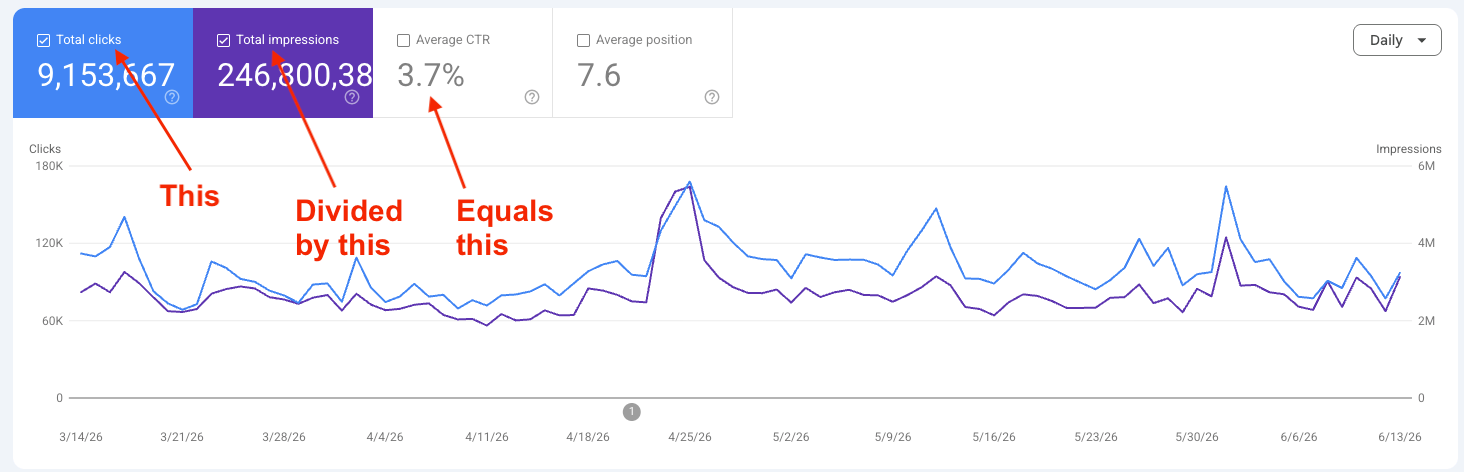
Using the numbers from this GSC screenshot:
9,153,667 ÷ 246,800,380 = 3.7%
In other words, for every 100 times a page from this website appeared in Google search results, it was clicked roughly 3.7 times.
4 possible reasons organic CTR in Google is down
1. Your rankings are down
Changes to rankings is one of the most common reasons that CTR may go down on a website. We know that around 30% of all organic websites clicks from Google go to the page that is ranking number one.
As you go further down the SERPs, CTR drops off very quickly. So much so that if you drop from number 1 to number 3 in the organic search results you can expect your CTR to drop by almost half.
If you’ve noticed that your CTR is down for a particular page, it’s worth reviewing the top queries from that page and identifying any significant changes to positions.
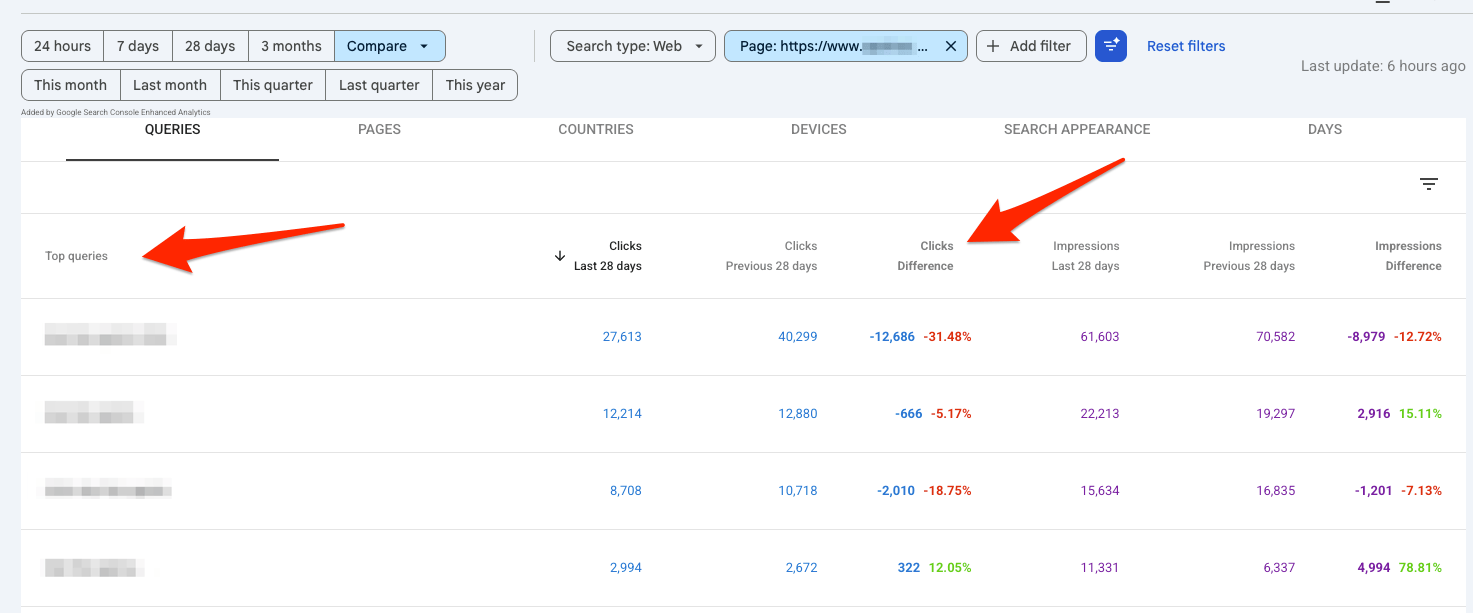
Given that Google Search Console data can be delayed, having a separate keyword tracker set up for 2-3 key search terms per page is a really useful way to spot changes to rankings that can impact your CTR before they become a bigger issue.
2. SERP Layout Changes
SERP layout and particularly changes to how many pages are displayed on page one and how many ads are displayed on page one can have a big impact on CTR.
It used to be widely accepted that Google displayed 10 listings on page 1 of Google. Today, however, that number hovers around 8. Here’s an example of how you could be consistently ranking number nine, but your CTR could drop dramatically due to SERP layout changes.
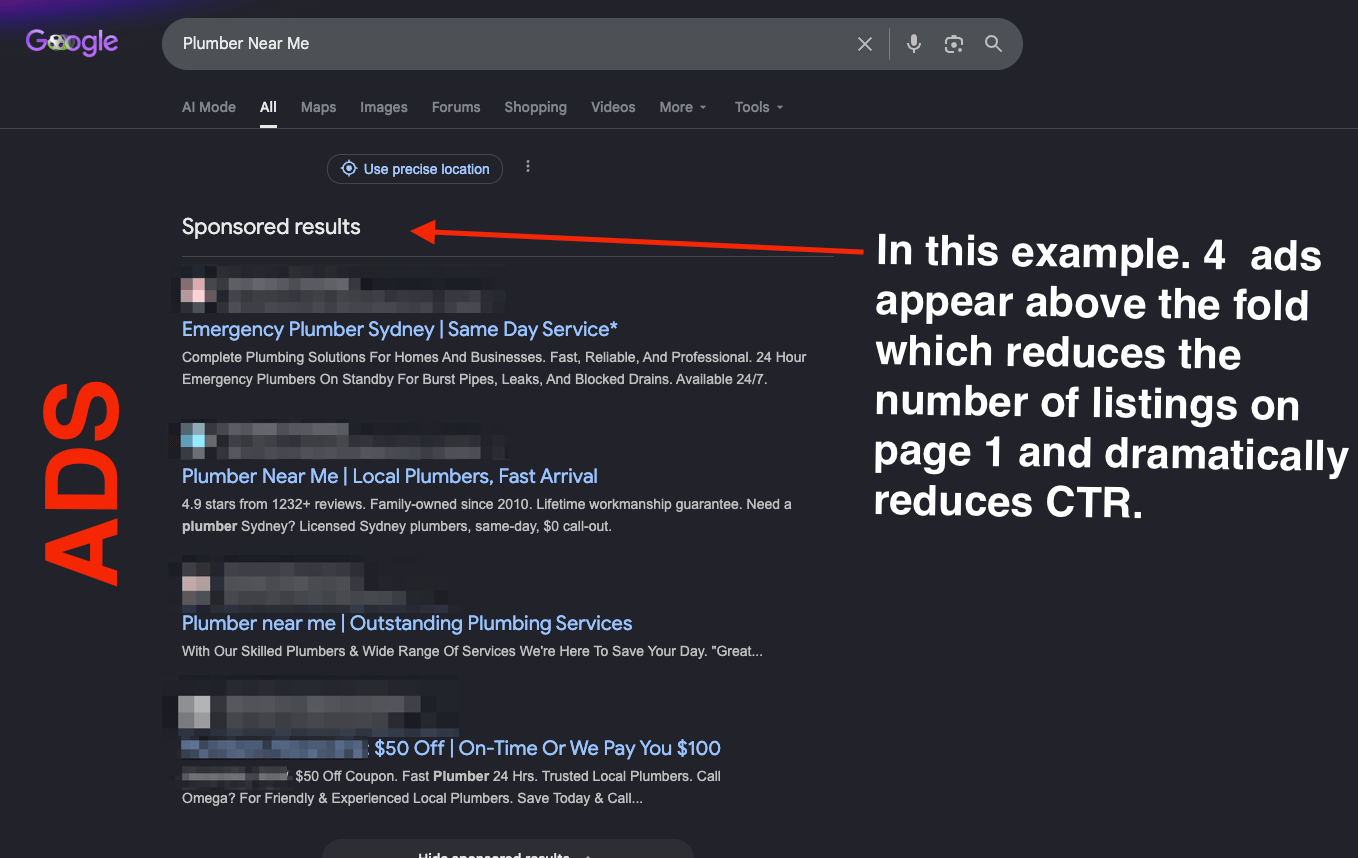
Old layout (10 organic results)
Position #9 = page 1: visible without much scrolling past ads
Estimated CTR at #9: ~3%
New layout (8 organic results + more ads)
Position #9 = page 2: Effectively invisible as <1% of users click through to page 2
Estimated CTR at #9: ~0.5% – your position remains the same by your CTR is down by 83%
The solution is straightforward but not simple – you need to improve your rankings. Google is constantly testing new SERP layouts. More prominent Ads as well as fewer blue links on page one means that if you’re not in the top 6-7, then you are no longer “guaranteed” to appear on the first page of Google.
3. Google AI Overviews
We left this until number 3 on the list. The reality, however, is that Google’s AI overviews is the number one reason why organic CTRs are falling across the board.
If you have noticed changes to your CTR – particularly when comparing 2025 to 2026 data – then there is a very good chance that Google’s AI Overviews is the culprit for these changes.
The latest data revealed that AI Overviews (AIO) have caused organic CTRs to fall – on average – by 35% over the past 12-months.
At the time of writing, almost 60% of searches trigger an AI overview to appear. When an AI overview appears, users are far less likely to click through to any website. 27.2% of searches now result in zero clicks and this number is growing quickly with some outlets estimating the figure could be closer to 60%.
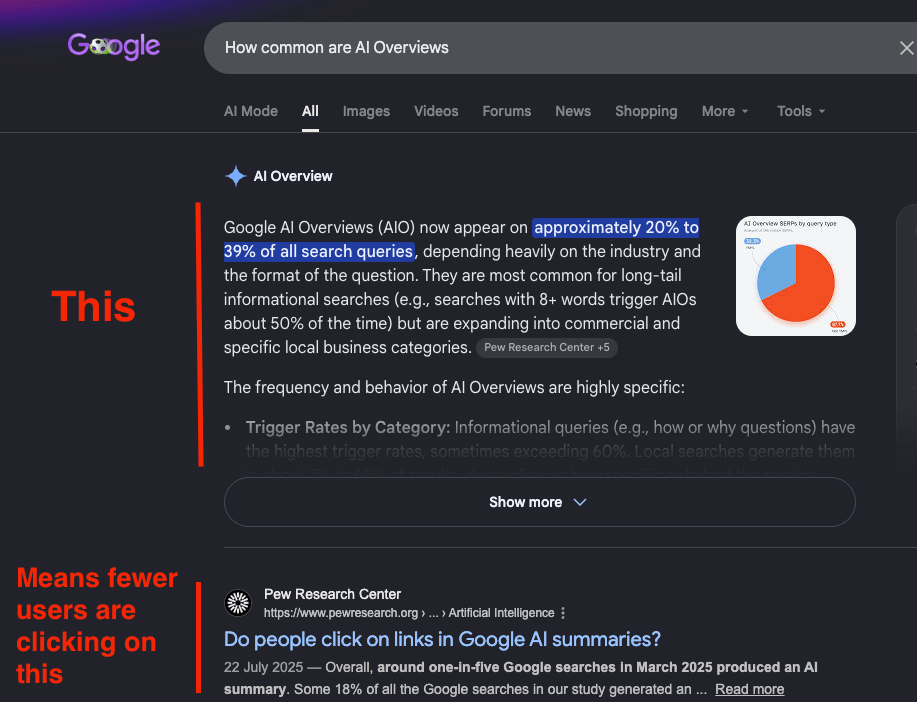
If you’re looking at website CTRs, it’s important to look take your baselines from a post AIO era. Comparing pre-AIO CTRs with post-AIO CTRs is a recipe for disappointment. The reality is that Google’s AIO are causing CTRs to drop. Whilst there are certain things on this list that you can do to rectify changes to CTRs – the prominence of AIOs is one thing that is beyond the control of every website owner.
4. You are bidding on your brand name in Google Ads
Bidding on your brand name in Google Ads is one of the most common culprits for CTR drops. If you are looking at a sitewide CTR, then you will notice that the CTR that you get for your brand name is – naturally – much higher that the CTR that you get for brand-agnostic search term.
The reason is pretty simple – if users are searching for your brand name in Google, then they are essentially using Google as a navigational tool to get to your website. Alternatively, when a user is searching for a product, service, or answer, they are comparing you against other websites and may not be aware of your brand.
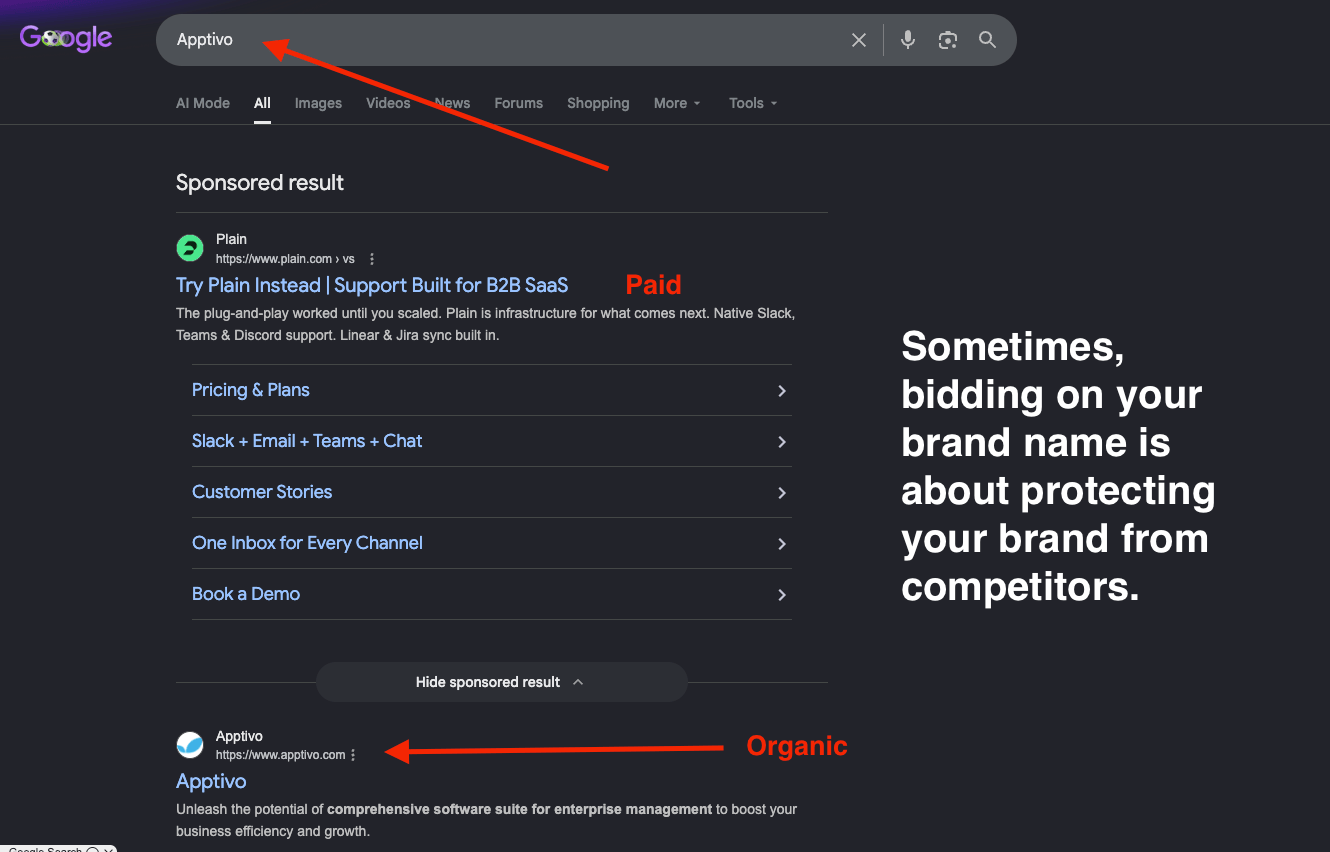
Branded CTR is generally around 10-20x higher than non-branded CTR – which is no surprise. However, if you see that your website CTR has dropped from say 2-3% down to 1%, then that may come as a shock. If that’s the case, it’s important to look at any changes to your Google Ads campaigns. If you have gone from not bidding on your brand name to bidding on your brand name, then your organic CTR is naturally going to drop.
The traffic that would normally come to the website when someone searches for branded searches is now being attributed to Google Ads.
Should you bid on your own brand name?
It depends on what your competitors are doing.
If competitors are bidding on your brand terms, they’re showing up in paid results every time someone searches for you by name and intercepting customers who were already looking for you – then bidding on your brand means protecting those searches. In that scenario, not bidding means handing them an easy win.
Final thoughts
Some changes to CTR – like ranking drops and bidding on your brand name are within your control. Others, like changes to SERP features and Google’s increasingly present AI Overviews are beyond your control. The latter – Google AI Overviews is the number one reason that we are seeing changes to CTRs en masse across our client accounts between 2025 and 2026 data.
If you are fretting about changes to CTR, then it’s important to set up proper tracking so that you are looking at comparable data. Comparing pre-AIO CTRs with post-AIO CTRs is a losing battle. Don’t stress the things that you cannot control – focus on the elements that you can control to improve CTRs.