
The SEO space is changing – fast.
It’s a broad statement. In fact, if you look back over the last decade, the sentiment has been shared by SEOs from across the globe every year. In 2026, however, it’s fair to say that SEO is changing faster than ever and those that don’t adapt are quickly getting left behind.
How and where users are searching is changing which is having a knock-on effect on every website. As we move through 2026, we’ve compiled a list of 6 SEO trends that we are seeing that are reshaping organic search and changing how we approach SEO for our clients.
SEO Trend #1: A continued increase of zero click searches
This should come as a surprise to no one – clicks are decreasing and zero click searches are skyrocketing. This isn’t a new trend, but it’s #1 on our list of SEO trends for 2026 due to just how much it is shaping the way that marketers think about SEO.
The latest data shows that 27.2% of all searches are now zero-click, with more users getting the information they need directly from the SERPs without needing to click through to a website. A big driver of this shift is the continued rollout of Google’s AI Overviews, which now appear on 21% of all search results and reduce click-through rate (CTR) by almost 35% when present. The impact is even more pronounced for informational queries, which account for 99% of all AI Overviews, and local searches, where a whopping 68% now trigger an AIO to appear.
The reality is that the increase in zero click searches isn’t going to stop.
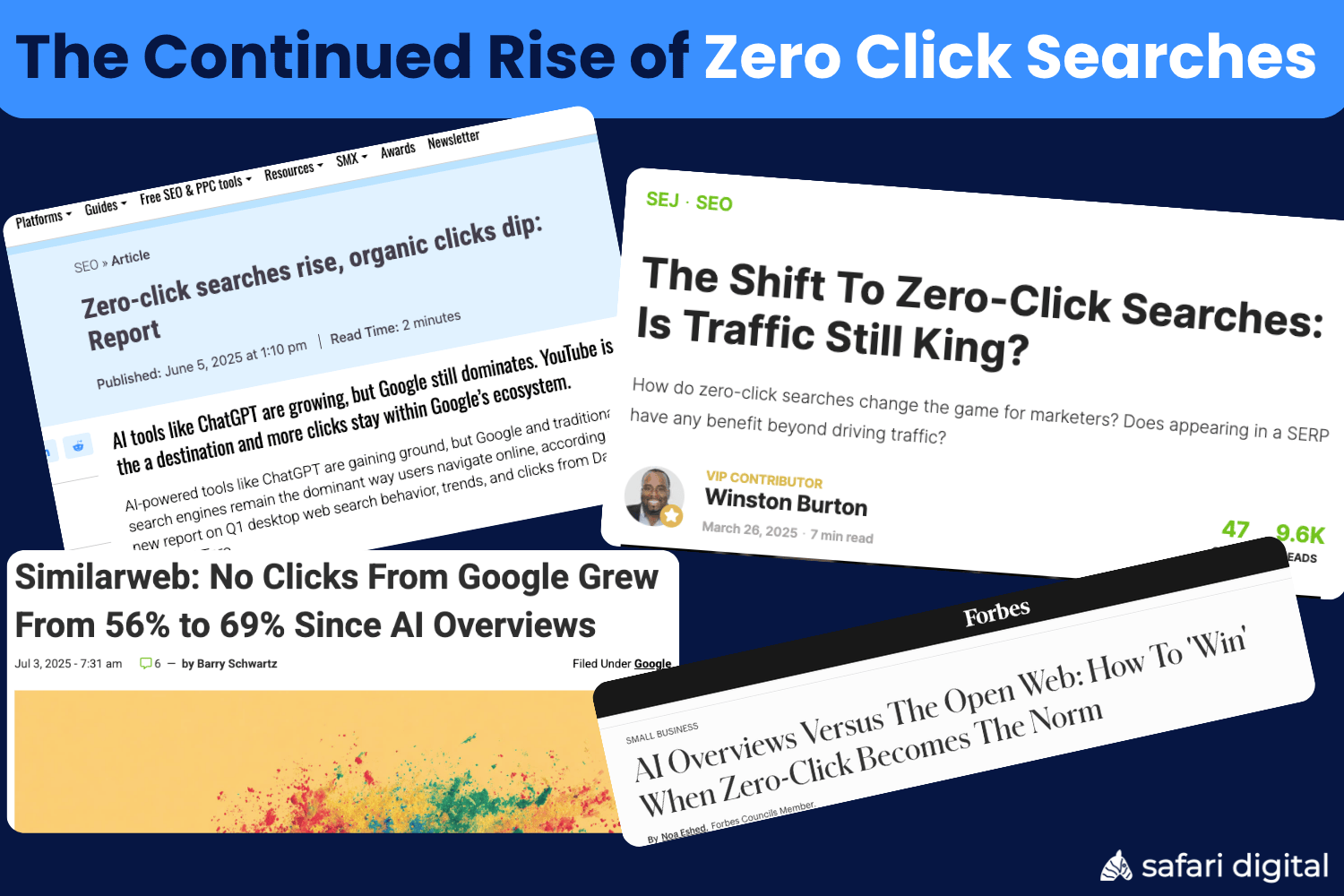
AI overviews are extremely pervasive and for many searches they serve the purpose – provide a succinct answer to the question. Chasing clicks lost to zero click queries is a losing battle. In order to survive, publishers need to focus on the searches that translate to revenue – whatever that revenue model may be. It’s important to understand what can and what cannot be recovered.
Now, more than ever, businesses who rely on their organic presence to generate leads, enquiries, sales, or any type of revenue need to implement tracking to understand how they can leverage valuable pages and resources. Better tracking won’t stop zero click searches; however, it will help businesses to understand more about how their customers search and how they can ensure that traffic that creates revenue is a focus.
As we have been telling our customers for the last 12-months, you don’t necessarily need more traffic, you just need to make better use of high-quality traffic.
SEO Trend #2: A crackdown of list articles for LLM manipulation
Towards the end of 2023 we starting to notice an increase in the number of “best of” articles that were being published by businesses. In essence, the concept was that a businesses would write an “X Best *Service/Product*” list and rank themselves at the top of that list. The idea was twofold:
- Rank organically in Google for when a user was searching for “*Best *Service/Product*”
- Influence LLMs by ranking your own website at the top of that list
The second part of that intention – influencing LLMs – was the biggest reason behind the sudden influx of “best” listicles. Businesses were scrambling to create generic, ill-conceived articles that helped to skew the results seen in LLLMs like ChatGPT and Perplexity.
The truth was, in 2024 and even right up until today, those lists have been largely effective at achieving those objectives. In the first part of 2026, however, this is starting to change.
In early February 2026, Lily Ray published a very good piece on the matter.
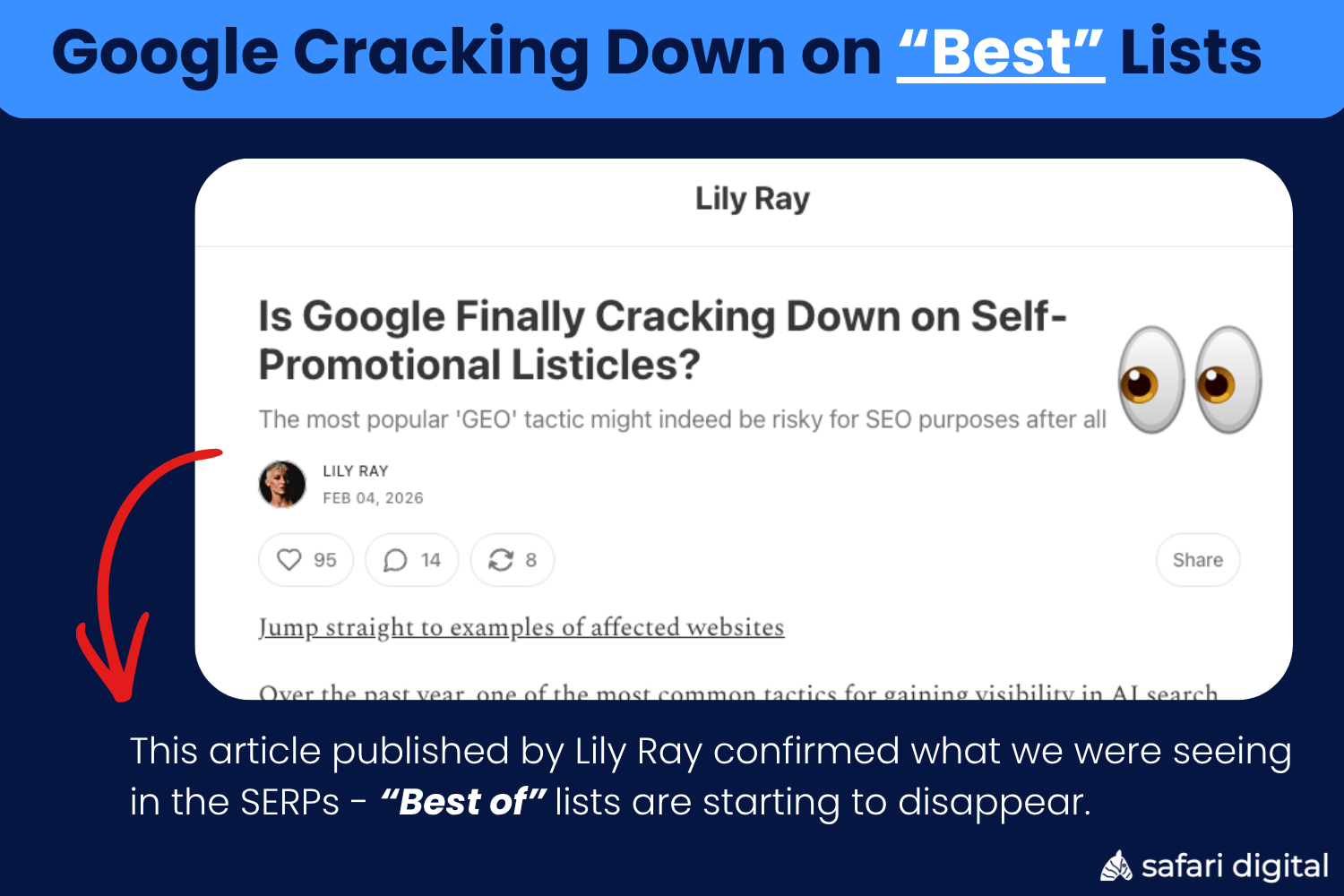
Following significant ranking volatility that hit in mid-to-late January and in the lead up to the March 2026 Spam and Core Updates, Ray analysed a number of well-known SaaS brands that had seen sharp organic visibility declines – one $8B B2B brand dropped 49%, with others falling between 29% and 43%. The common thread amongst all of these companies was blogs filled with self-promotional “best of” listicles, often scaled rapidly with AI. Ray also noted that these SEO declines were dragging AI search visibility down with them, affecting citations in AI Overviews and beyond.
We expect to see this trend extend into 2026 and beyond with this temporary LLM ranking loophole being shutdown courtesy of Google de-ranking these articles. Remember, the success of these articles in LLMs hinges on organic visibility (which is where LLMs pull data). By reducing visibility, the LLM influence goes out the window.
SEO Trend #3: Websites obliterated through AI content abuse
As a Sydney SEO agency, we tend to greet a lot of our prospective clients when they are in a crisis.
When things are going well, people typically don’t think that they need help. When things start to crash and burn, however, they quickly need help remedying what’s been done.
Over the last few years we’ve experienced a stark increase in the number of enquiries that we get from businesses who have gone down the AI-content rabbit hole.
For many businesses, the ability to create content with zero effort and input was seen as a way to expedite content production for a fraction of the cost. AI content effectively reduced the barrier to entry for many businesses who couldn’t afford content writers or didn’t have the in-house expertise. The barrier to entry became significantly lower and, as such, content output skyrocketed and Google was now contending with millions of almost identical pieces of content pushing the same opinions and providing the same generic information.
The interesting part about this phenomena is that it’s not just reserved for businesses on a shoe-string budget. We’ve seen large businesses with internal content teams go down the same path and get the same dismal results.
Why? Well, because AI-content was seen not just as a way to reduce effort, but also to expedite output. Instead of putting out one high quality, well researched piece of content each month that draws on experience and provides a unique point of view, companies are now publishing 10 a week with no effort and expecting to 10x the result.
In reality, publishing AI content causes significantly more harm than good. When faced with the choice of producing and publishing no content or publishing AI-generated content, our advice is always to publish nothing. Sure, you’re not going to grow or generate new sources of traffic, however, publishing nothing at least means you’re not going to harm the existing pages on your website (typically the high-value transactional ones) that are currently generating traffic and leads.
The trends that we are seeing in 2026 and expect to see continue into the coming years is that websites who go down the AI-content path will continue to be punished.
Interestingly, Google does not explicitly state that AI content is inherently problematic for SEO. In fact, its documentation was updated last year to clarify that content is rewarded based on value – however it is produced.
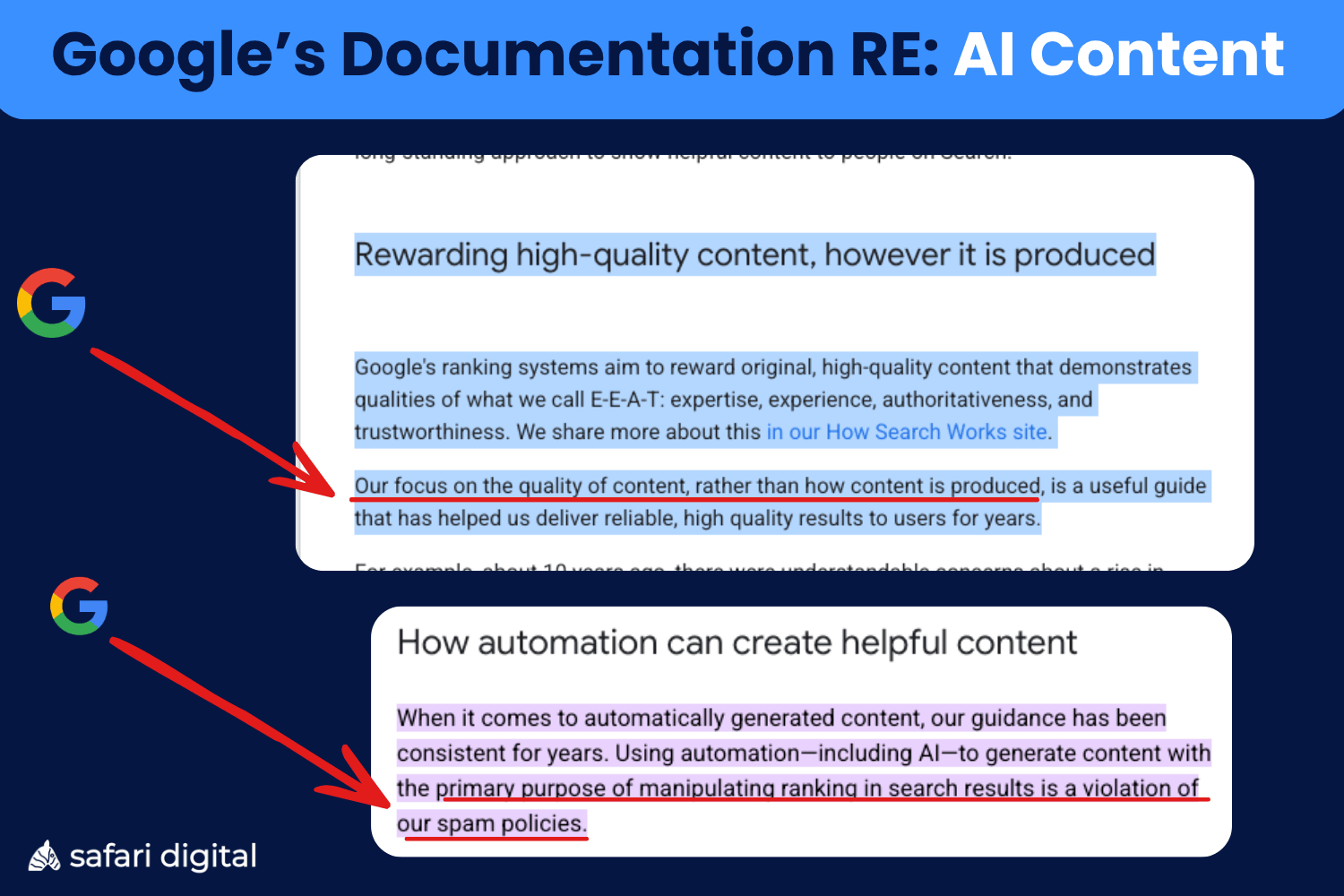
Here’s what Google’s Search guidance says about AI-generated content:
“As explained, however content is produced, those seeking success in Google Search should be looking to produce original, high-quality, people-first content demonstrating qualities E-E-A-T.”
There is plenty of information online that contradicts this view point – and that’s fine, interpret it at your own peril. The fact is that there may be a loophole here where AI can be used effectively. However, we can tell you from experience that the chances of you finding that are slim to none. Pushing low-quality, generic AI content is the number one reason that we see websites crash and burn in 2026.
SEO Trend #4: Reddit + SEO manipulation is tightening
Google and reddit announced a content licensing partnership back in February 2024. Effectively, Google received access to Reddit for training it’s artificial intelligence and in return Reddit received $60 million per year and a huge increase in organic search visibility. Hence why you now see Reddit results on just about any informational search.
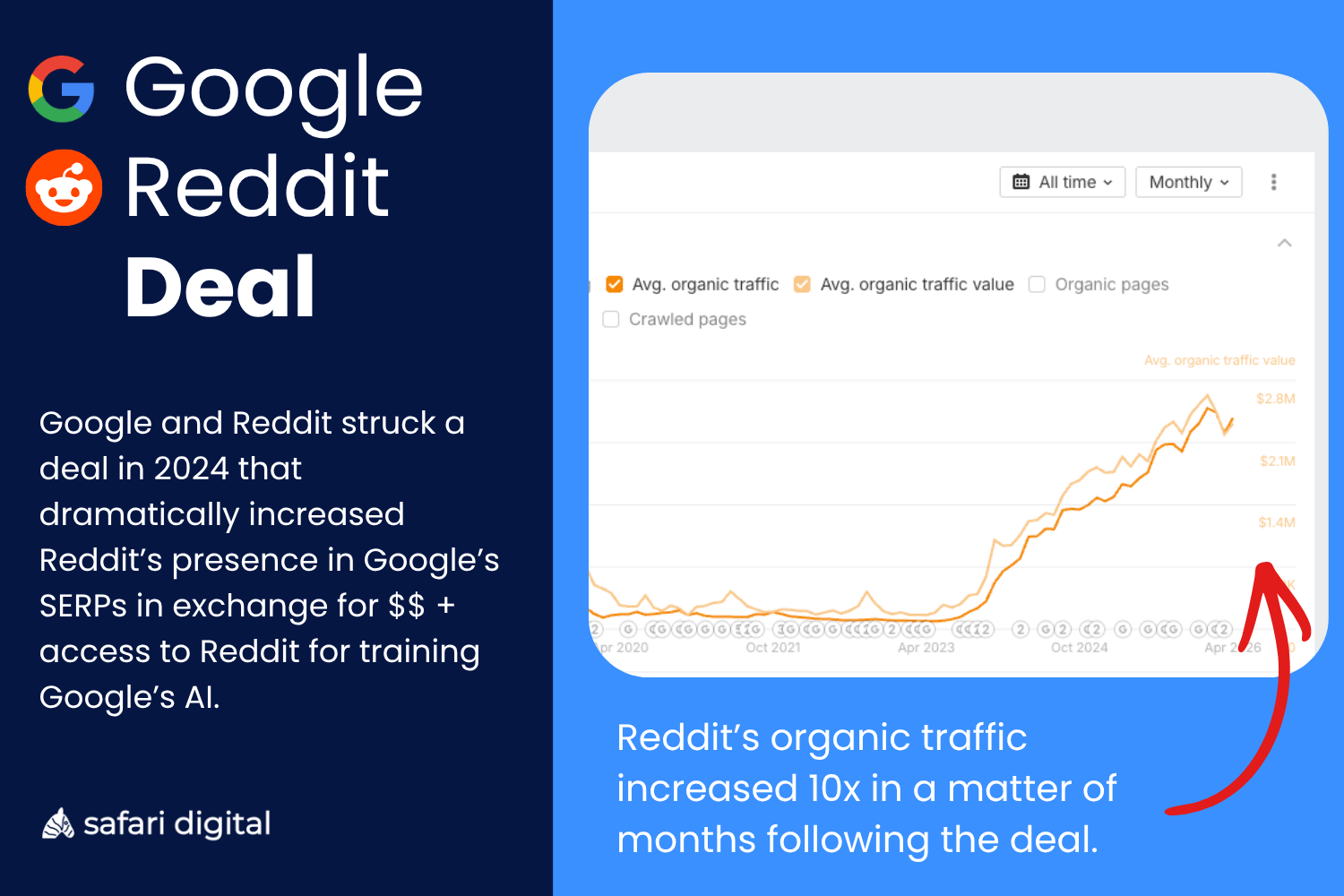
The outcome was more “user generated” (Reddit user, that is) content in the search results. Quickly, the SEO community smelled blood in the water and decided that spamming Reddit with brand mentions and links (despite being no follow) was a free ticket to increase LLM visibility.
In reality, the result was that Reddit communities were now being spammed with comments similar to what we saw on blog comment sections and forums 10-15 years back. This meant more work for Mods who were forced to delete promotional content and users quickly became vocal in letting offenders know that they are not welcome.
If there’s one thing to know about Reddit, it’s that the communities don’t stand for disingenuous or promotional engagement. Not only that, but they can also smell it from a mile away and will be quick to call you out.
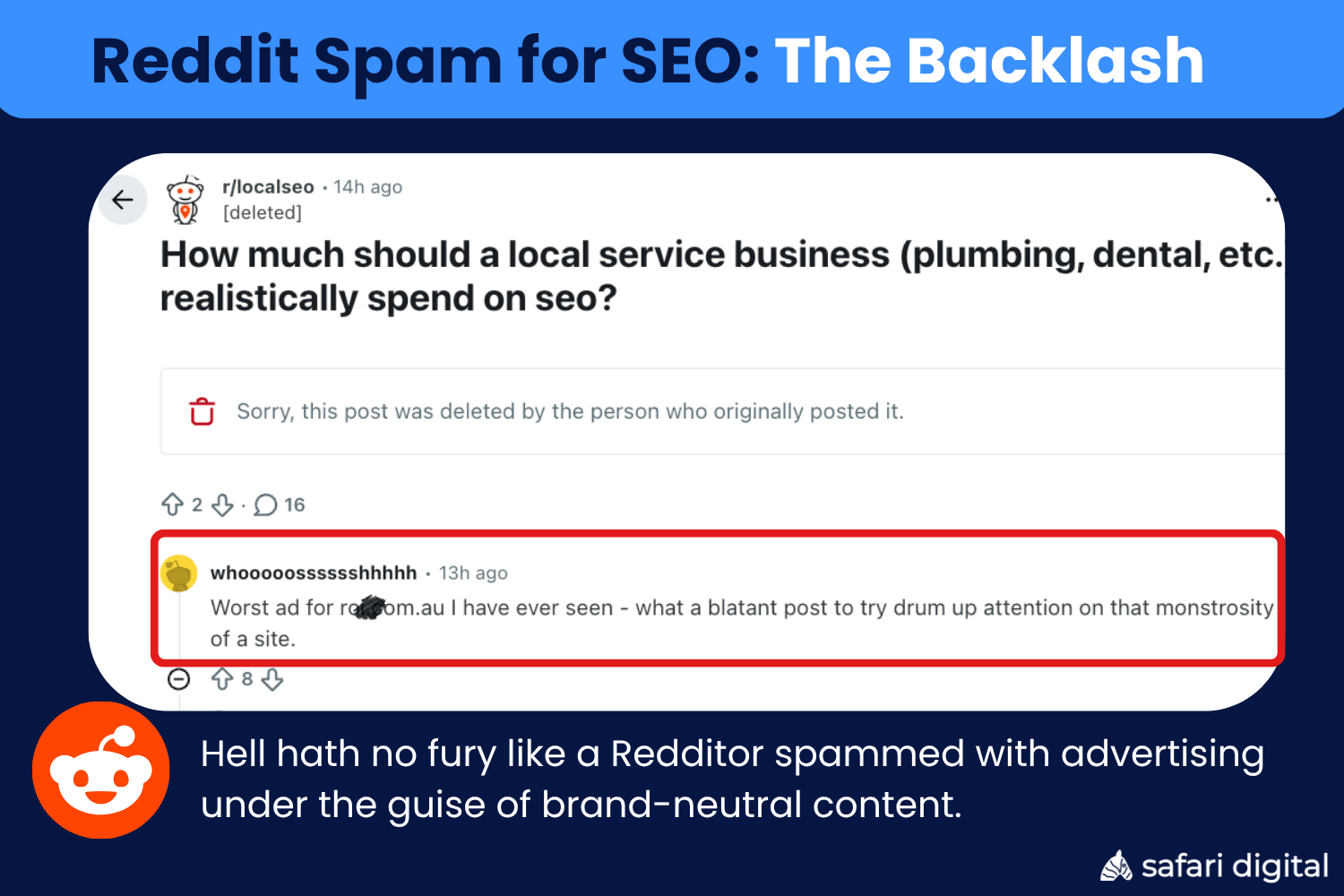
In 2026, expect to see the Reddit spamming trend begin to die down. It won’t go away; however, we have already seen a significant crack down from reddit Mods and a decrease in the number of brands spamming reddit with promotional content.
Positive interaction and brand sentiment on Reddit can still be very beneficial for SEO. However, that interaction and sentiment can’t be forced from empty accounts – it needs to come from trusted sources and users.
SEO Trend #5: Proving authority is becoming harder
The influx of AI-generated content means that it is now harder than ever to prove authority and create content that is genuinely valuable.
You could look at this two ways:
- AI generated content means it’s now hard to rank because there are so many other similar resources already being published.
- AI generated content means that unique, expert-written content now stands out more than ever.
In reality, it’s probably a combination of the two.
Yes, there is greater opportunity for those creating high-quality, expert-led content. However, the reality is that proving that expertise is now harder than ever before. It’s not enough to simply publish content that you believe is helpful. You need to provide something that can’t be replicated and that doesn’t already exist.
The truth is that writing human content isn’t enough. What you write and publish needs to be unique, offer an additional or new viewpoint, and you need to be able to substantiate what you are writing.
This applies for both transactional landing pages and for blogs. It’s not enough to write “Why choose us” and fill it with superlatives and fluff – it needs to be substantiated with data. The companies that are winning are providing a unique perspective and backing it up with first-hand data.
SEO Trend #6: Powerful content entities are collapsing
There is a misconception that Google is giving preferential treatment to a select number of established entities in each field. Whether that’s SaaS, marketing, retail, or any other industry, it’s important to clarify that this couldn’t be further from the truth.
Powerful, established content entities are starting to collapse. Many of them are collapsing under the weight of a fully-fledged AI content offensive that they’ve been waging over the last few years. Others are collapsing because the generic, low-value, high-word-count content that they were producing is no longer resonating with users and is being de-ranked in search engines.
Over the last 12-months we’ve seen a notable diversification of the search results. New players are entering and existing websites that were dominating their niches with a heavy-handed approach to content are beginning to flounder.
The HubSpot blog – once a powerful content platform that dominated all things CRM, marketing, and business is rapidly disappearing from the search results.
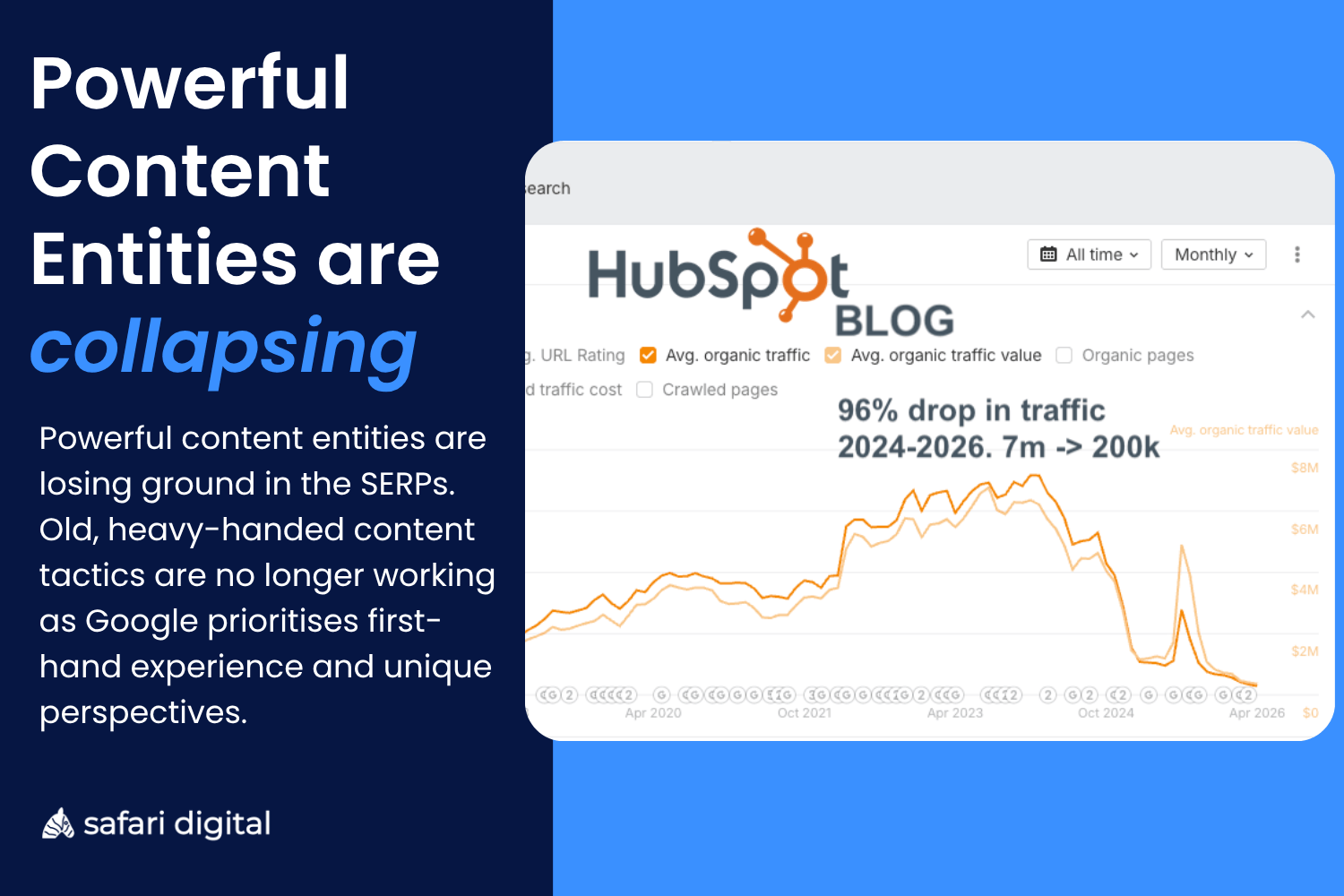
This is just one example. Do a year over year comparison of the SERPs and you’ll see this SEO trend is happening across just about every industry.
The message is pretty clear – no one is safe. Websites that relied on entity strength for ranking are no longer able to expedite their way to page one. Instead, top positions are up for grabs for publishers offering real insights, unique perspectives, and fresh ideas. By any measure, this change has been a win for both users and for smaller sites that prioritise high-value content.
