Before you can claim your spot at the top of the Google search results, you first need to get your site crawled and indexed by the Google spider.
The amount of time that it takes to get your site crawled and indexed in Google will depend on several important factors.
One of the most common questions that we receive from new website owners is:
“I set my site live two weeks ago and Google still hasn’t indexed it, how come?”
The truth is, getting a website crawled and indexed by Google is far more complicated than it was five or six years ago. Google crawlers are busy; the latest data suggests that there are more than 200-million active websites globally, with Google including more than 55-billion web pages in its index.
Today, websites must be easy to crawl and deliver value to visitors. Publishing low quality, duplicate, or copied content can leave your website on the sidelines.
How Long Will It Take Google to Index My Site?
The average time for Google to discover and index a new URL is ~20 hours, whilst the amount of time it takes for Google to crawl and refresh a known URL is around 30 days. Overall site health and quality has a discernible difference on how long it takes and whether or not Google chooses to index a page at all.
Average Indexing Time by Site
- Small websites (less than 100 pages) – 4-days to 6-weeks
- Medium websites (up to 1,000 pages) – 14-days to 12-weeks
- Large websites (1,000+ web pages) – 1-month to 6-months
- Extra Large websites (100,000+ web pages) – 6-months+
These figures are for indicative purposes only. The amount of time it takes for Google to index your website will depend on a myriad of technical factors, content quality, and the industry in which your website operates. If your website exceeds the above timelines by more than 50%, we recommend speaking with an SEO consultant – there may be more significant issues at play.
Update – October 2026 – New Information from Google’s Gary Illyes
Gary Illyes from Google presented new data from Google Search on how long it takes different types of content (new vs. old) to get crawled and indexed (on average) by Google. This new information was presented by Illyes at the three day Google Search Central Live Deep Dive event in Europe. The new data provides some more concrete information around indexing timelines.
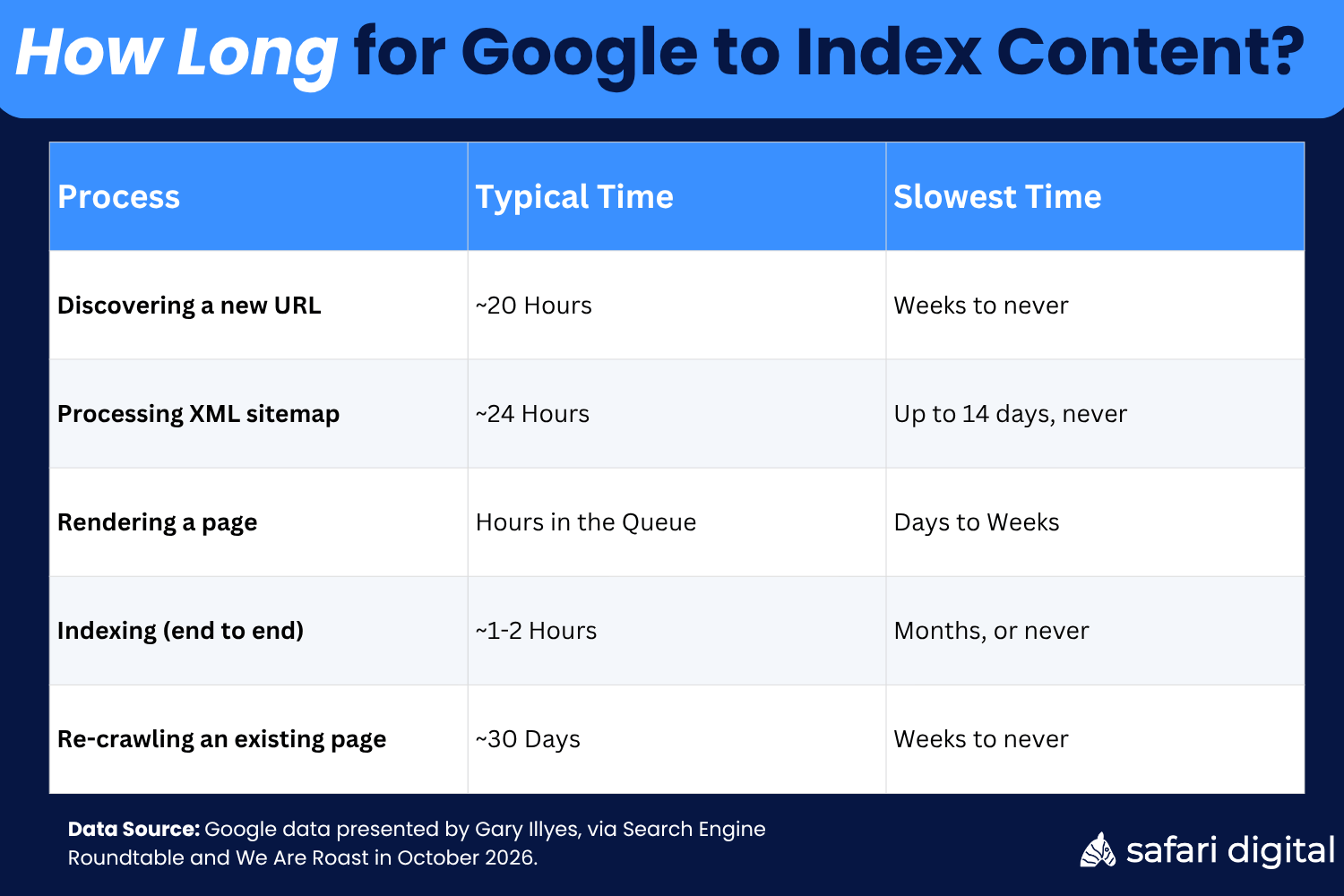
- New URL discovery: ~20 hours typical; slowest is weeks to never
- Refreshing a known URL: ~30 days typical
- Sitemap processing: ~24 hours typical; up to 14 days, or never (for quality reasons)
- Rendering: seconds to render but hours in the queue; slowest is days to weeks
- Indexing end to end: ~1.5 hours typical; months or never (quality), where “end to end” means all the critical processes finish successfully
- Canonicalisation changes: 1-3 weeks typical; months with conflicting signals
- Site moves/migrating to new URL: 1-3 months typical; 6 months to 1 year+ at worst
| Process | Typical Time | Slowest Time |
|---|---|---|
| Discovering a new URL | ~20 Hours | Weeks to never |
| Processing XML sitemap | ~24 Hours | Up to 14 days, never |
| Rendering a page | Hours in the Queue | Days to Weeks |
| Indexing (end to end) | ~1-2 Hours | Months, or never |
| Re-crawling an existing page | ~30 Days | Weeks to never |
Data Source: Google data presented by Gary Illyes, via Search Engine Roundtable and We Are Roast in October 2026.
How can I make Google index my site faster?
Google crawls and indexes billions of new web pages every day. To stay on top, you need to create a website that is easy for Google to crawl and share content that is worthy of being included in Google’s index. If crawl bots cannot find, access, and crawl the various pages on your website, it will take longer for your website to index.
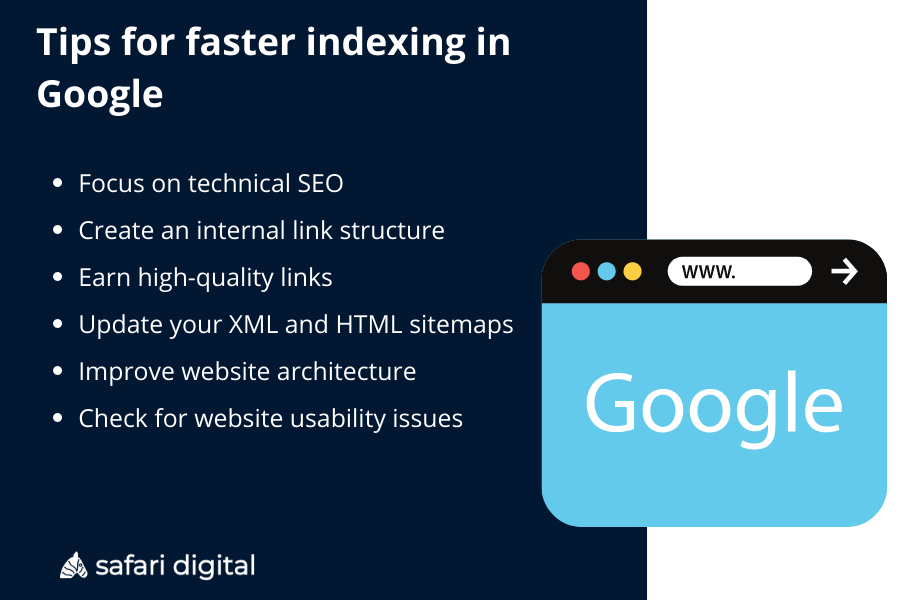
- Create an internal linking structure that encourages website crawling
- Check for website errors or usability problems
- Regularly update your site and add new content
- Earn high-quality backlinks from other reputable websites
- Improve website architecture and basic technical SEO principles
- Have a dynamic XML sitemap and submit it to Google Search Console
- Create an HTML sitemap and update it on your website as pages change
- Request an individual URL crawl (note: this is not as effective as it once was)
- Syndicate new content to social media platforms
- Create valuable website content
- Review your website URL structure
Google wants to index websites that provide value to users. Work your way through the above checklist to ensure that your website is delivering value and worthy of being included in Google’s index.
How can I check if my website has been crawled by Google?
To check if your website has been crawled or the last time that a page was crawled by Google, you need to set up and familiarise yourself with Google Search Console. The average crawl time for a new web page can be anywhere from 3 days to 4-weeks.
Once you have configured Google search console, you can follow these directions:
- Login to Google Search Console
- Navigate to ‘Settings’ on the left-hand side menu
- In the settings section, find ‘Crawl Stats’
- Click ‘Open Report’
- You can view the ‘Crawl Requests Breakdown’ section to find crawl by response code
That’s it – you’re done! Searching through the crawl requests breakdown by response code, you will be able to see the last time that a Google crawl bot visited individual website pages.

Wrapping up
Google search bots have a lot on their plate. 200-million active websites and more than 55-billion indexed web pages mean that crawl bots are in high demand, which means that your website must be accessible and valuable to be included in Google’s index.
If your website is technically sound, but you still cannot get it to index, it’s essential to ask yourself, “is my site worthy of being indexed by Google?”. Creating content and delivering an on-site experience that provides real value to visitors is an essential consideration when Google crawls, indexes, and ranks websites.
Still having trouble getting your website indexed and found on Google? It may be time to seek the advice of an SEO expert who can understand the issues and dissect any issues in your Google Search Console. Our SEO Canberra team is here to help, get in touch today to find out how we can get your website back on track.